breaking away from the norm

REDESIGN PROCESSES
Redesign is not about changing the look. It’s about changing the product completely

Don’t start from design. Start from big strategic questions. Why do we do it and what do we want to achieve? It’s the designers who should ask these questions. Designers must be engaged in all aspects; the design must be coherent with strategy and content changes. Otherwise it will fail.

I have seen many ‘nice’ designs that didn’t raise the circulation. On the contrary, some of them almost killed the newspaper. Why? Because those were good designs for the wrong audiences.


This is the new role of the designer; to be in the process from the very beginning, from shaping strategy, to the very end, to micro typography. Give power to designers! Conscious designers,
that is
.


This kind of redesign process, which is more holistic and engages many departments, can enormously motivate all workers. And boost results. That’s why we had such growth after redesign. We call it inner branding.

Design can change not only your product, but also your workflow, branding, and your company. It can change even you.


What is branding?

Q: What is the highest level of branding?
A: When you have successfully transferred the allegiance of your (potential) customers from your products or services to an artificial personality known as your brand

Our definition of branding is:
The creation, development and maintenance of a mutually-valuable relationship with a strategically selected group of customers, through the medium of a fresh and compelling elaborated proposition that is delivered consistently over time by an artificial personality.

The key elements of this definition are:

  1. “a mutually-valuable relationship” – customer retention can be the result of a “mutually-binding relationship” where the customer is held hostage through the effects of a monopoly or contractual terms, but this will not be a valuable relationship, even to the supplier. Customers who are hostages become terrorists, raising significantly the supplier’s cost-to-serve, and declining cross-buying or additional purchase opportunities. As Bain & Co has amply demonstrated, customers are profitable only when they appreciate the supplier
  2. “a strategically selected group of customers” – means that strong brands segment their potential customers carefully, and do not expect to be able to supply a valuable service to everyone. BMW reputedly count who should not be driving BMWs, and start to worry if more than 12% is outside their focused market segment, as it is strong evidence that the BMW brand is being diluted. The respect/stature part of a brand can be as warm as sunlight and attract everyone, but the intimacy part of a brand should be like a laser beam
  3. “a fresh and compelling elaborated proposition” (brand definition) – is one where the key emotional and visual elements have been defined, as well as the rational benefits. What is the personality of the brand? What is its central organising thought? What does it stand for, and against? And the proposition must be continually refreshed. New stories must be told about it. During the Labour Government of the 1960s, Premier Harold Wilson insisted that a new topic be addressed every week. The recent Blair administration clearly used the same technique to keep the government looking on the ball
  4. “delivered consistently over time” – by whoever touches the brand. The marketing communications have to be consistent, but so does the call center, and the stories told by employees at parties, and how distributors (and other intermediaries) treat the brand. Research suggests that loyal brand customers are somewhat forgiving of occasionally inconsistent marginal behavior – a brand is a human being, after all – but this should not happen too often
  5. "by an artificial personality" - the strongest human relationships are not with things but with other people. A brand can be such a person, someone to respect, admire and love. In its strongest form, your brand is the leader of a cult / tribe, an "A" list personality, a major mover, shaker, and shaper of the world that people want and even need, to be associated with and to accompany along the way
Do you have an edge? How is your brand? Is it recognized? Is it defining what the business should be? Does it say professionalism? Are you attracting your target group? What about personal branding ?

How to advertise effectively

1. What do you have to say that matters to your customer? I'm your prospective customer. I know you want my business, but why should I care? What's in it for me? Most ads are written under the assumption that the reader, listener or viewer has a basic level of interest and is paying close attention to the ad. But customers tend to ignore all ads that do not speak directly to them. Your first task is not media selection; it's message selection.

2. Can you say it persuasively? Most ads are ineffective because the writer was trying to say too much, include too much and be too much. Fearful of leaving someone out, these writers write vague, all-encompassing ads that speak specifically to no one. "We Fix Cars" is a terrible headline for an ad.

3. Are you speaking to a felt need? Let's say the "We Fix Cars" auto mechanic has a great deal of affection for older BMW 2002s. He knows that 2002 owners love their cars like few drivers on the road and that the only weakness of the 2002 is its evil Solex carburetor. Every 2002 owner knows this, too. So he writes the headline, "BMW 2002 Owners: Aren't You Tired of Fooling With That Solex by Now?" In the body of the ad, he talks about the fabulous new Weber two-barrel carburetor now available for BMW 2002s, raves about how it dramatically increases performance and reliability, explains that he keeps these new Weber carburetors in stock at his shop, then names the price at which he will install and adjust that carburetor for you. He closes the ad by saying, "You'll rocket out of here in a completely different BMW than the one you drove in." If a list of BMW owners in your area is available for a direct-mail card (such as the list from the local BMW club), then a direct-mail card or flier would be the way to go. But if no such list is available, the newspaper might be a second choice. In either case, you'd want to include a large picture of a BMW 2002 to serve as a recall cue and help gain the attention of your target customer.

4. How long is your time horizon? Some ads build traffic, some build relationships and others build your reputation. If you don't have the financial resources to launch a true branding campaign focused on building relationships and reputation among potential customers, you're going to have to settle for traffic-building ads until you can afford to begin developing your brand. To what degree do you have financial staying power?

5. What is the urgency of your message? If you need an ad to produce immediate results, your offer must have a time limit. This technique will simultaneously work for and against you. On one hand, customers tend to delay what can be delayed, so limited-time offers generate traffic more quickly since the threat of "losing the opportunity" is real. On the other hand, customers have no memory of messages that have expired; short-term messages are erased from our brains immediately. Therefore, it's extremely difficult to create long-term awareness with a series of limited-time-offer, short-term ads.

6. What is the impact quotient of your ad? How good your ad must be depends on the quality of your competitors' ads. A .22-caliber pistol is a weapon against an opponent with a peashooter. But aim that pathetic pistol at an opponent holding a machine gun, and you can kiss your silly butt goodbye. How powerful is the message of the opposition? If your competitor carries a machine gun, don't go where he goes. In other words, don't use the media he uses.

7. How long is the purchase cycle? How long it will take your advertising to pay off is tied to the purchase cycle of your product. Ads for restaurants work more quickly than ads for sewing machines, because a larger percentage of people are looking for a good meal today than are looking for a machine that will let them make their own clothes. Likewise, an ad for a product we buy twice per year will produce results faster than an ad for a product we buy only once a year. Remember, a customer first has to be exposed to your ad often enough to remember it, then you have to wait for that customer to need what you sell. How soon will he or she likely need it?Link

Not hiring a professional is often far more expensive than hiring one.

Article taken from Entrepeneur.com Written by Roy Williams, founder and president of The Wizard of Ads, a company serving the advertising and marketing needs of business owners around the globe. Williams is also the author of The Wizard of Ads and Secret Formulas of the Wizard of Ads.

byleedesign can help with brand creation and strategy including ad writing and advertising timeline strategy.

8 Ways to Drive a Graphic Designer Mad

ahooooooou!
As everyone knows, graphic designers are the reason there are so many wars in this world. They get inside our heads with their subliminal advertising, force us against our will to spend money on the worst pieces of shit, and eventually, drive us to depression and random acts of violence. And of course, most of them are communists.

So to do my part to save the world from them, I made a list of things you can do when working with a graphic designer, to assure that they have a burn-out and leave this business FOREVER.

1 \\ Microsoft Office
When you have to send a graphic designer a document, make sure it’s made with a program from Microsoft Office. PC version if possible. If you have to send pictures, you’ll have more success in driving them mad if, instead of just sending a jpeg or a raw camera file, you embed the pictures inside a Microsoft Office document like Word or Powerpoint. Don’t forget to lower the resolution to 72 dpi so that they’ll have to contact you again for a higher quality version. When you send them the ‘higher’ version, make sure the size is at least 50% smaller. And if you’re using email to send the pictures, forget the attatchment once in a while.


2 \\ Fonts
If the graphic designer chooses Helvetica for a font, ask for Arial. If she chooses Arial, ask for Comic Sans. If she chooses Comic Sans, she’s already half-insane, so your job’s half done.

3 \\ More is better
Let’s say you want a newsletter designed. Graphic designers will always try to leave white space everywhere. Large margins, the leading and kerning of text, etc. They will tell you that they do this because it’s easier to read, and leads to a more clean, professional look. But do not believe those lies. The reason they do this is to make the document bigger, with more pages, so that it costs you more at the print shop. Why do they do it? Because graphic designers hate you. They also eat babies. Uncooked, raw baby meat.

So make sure you ask them to put smaller margins and really, really small text. Many different fonts are also suggested (bonus if you ask for Comic Sans, Arial or Sand). Ask for clipart. Ask for many pictures (if you don’t know how to send them, refer to #1). They will try to argue and defend their choices but don’t worry, in the end the client is always right and they will bow to your many requests.

4 \\ Logos
If you have to send a graphic designer a logo for a particular project, let’s say of a sponsor or partner, be sure to have it really really small and in a low-res gif or jpeg format. Again, bonus points if you insert it in a Word document before sending it. Now you might think that would be enough but if you really want to be successful in lowering the mental stability of a graphic designer, do your best to send a version of the logo over a hard to cut-out background. Black or white backgrounds should be avoided, as they are easy to cut-out with the darken or lighten layer style in photoshop. Once the graphic designer is done working on that bitmap logo, tell her you need it to be bigger.

If you need a custom made logo, make your own sketches on a napkin. Or better yet, make your 9 year old kid draw it. Your sketch shouldn’t take more than 5 minutes to make. You don’t want to make something that’s detailed and easy to understand, because the less the designer understands what you want, the more you can make her change things afterwards. Never accept the first logo. Never accept the 9th, make her do many changes, colors, fonts & clip art. Ask her to add a picture in the logo. Bevels. Gradients. Comic Sans. And when she’s at her 10th attempt, tell her that you like the 2nd one the most. I know, it’s mean but remember: graphic designers are the cause of breast cancer among middle aged women.

5 \\ Choosing your words
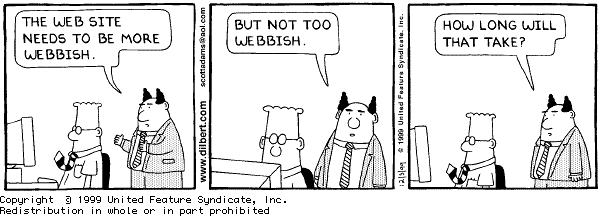
When describing what you want in a design, make sure to use terms that don’t really mean anything. Terms like ‘jazz it up a bit’ or ‘can you make it more webbish?’. ‘I would like the design to be beautiful’ or ‘I prefer nice graphics, graphics that, you know, when you look at them you go: Those are nice graphics.’ are other options. Don’t feel bad about it, you’ve got the right. In fact, it’s your duty because we all know that on fullmoons, graphic designers shapeshift into werewolves.

6 \\ Colors
The best way for you to pick colors (because you don’t want to let the graphic designer choose) is to write random colors on pieces of paper, put them in a hat and choose. The graphic designer will suggest to stay with 2-3 main colors at the most, but no - choose as many as you like, and make sure to do the hat thing in front of her. While doing it, sing a very annoying song.

7 \\ Deadlines
When it’s your turn to approve the design, take your time. There is no rush. Take two days. Take six. Just as long as when the deadline of the project approaches, you get back to the designer with more corrections and changes that she has time to make. After all, graphic designers are responsible for the 911 attacks.

8 \\ Finish her
After you’ve applied this list on your victim, it is part of human nature (although some would argue weather they’re human or not) to get a bit insecure. As she realises that she just can’t satisfy your needs, the graphic designer will most likely abandon all hopes of winning an argument and will just do whatever you tell her to do, without question. You want that in purple? Purple it is. Six different fonts? Sure!

You would think that at this point you have won, but don’t forget the goal of this: she has to quit this business. So be ready for the final blow: When making final decisions on colors, shapes, fonts, etc, tell her that you are disappointed by her lack of initiative. Tell her that after all, she is the designer and that she should be the one to put her expertise and talent at work, not you. That you were expecting more output and advices about design from her.

Tell her you’ve had enough with her lack of creativity and that you would rather do your own layouts on Publisher instead of paying for her services. And there you go. You should have graphic designer all tucked into a straight jacket in no time!

*Edit// Thanks to Cattya who took the time to create graphics on her translation of 8 ways to drive a graphic designer mad. I’ve added a couple here to make my post look better, but you’ll have to visit her site to see the rest! Written by ghislainroy.com

Note from the editor: This was posted on my old blog in March 2007, and it got shared by other blogs, emails and other social networking sites and generated over 75,000 page views and over 200 comments until it finally got printed in Dangerous Ink magazine during summer 2008. This is my 15 minutes of fame people, please read on!

reposter have adapted it to "her" and did some typo corrections too.

frame of thought


Sometimes we can be bugged down by others or by our own self thoughts. Optimism starts from our frame of thought. I am thinking of starting a series of posters that speaks positively. Words that can be a great reminder as we start the day. Have them in the bedroom, in the home office, at work or even in the bathroom. The pairing illustration can be placed side by side with the words or placed in another room. Let me know what you think (ONE) if this optimism posters. Is it worth pursuing? (TWO) I'm thinking of calling them "Thumbs Up". (THREE) Acid free paper or on Canvas. What do you reckon? You know of anyone needing a pat in the back?

I will give the 1st "Live the Dream" print to the contributor of my favourite feedback. Selection will be picked out by September 10.

Illustration 8.5 x 11 inches.
Printed on acid free paper or real canvas!

Printed with archival inks that will last you til you've lived out your dream!

Wally Amos, Famous Amos: “Making mistakes doesn’t mean that what you did was a failure, or the wrong take. It was just a ’mis-take.’ You need to go back and do another take. In each take there is a lesson.”

Jerry Greenfield, Ben & Jerry Homemade: “It really helps if you are doing something you love instead of something you are just spending a bunch of money on. You can become very discouraged if you’re not involved in something genuine, something that you believe in, and are committed to.”

Social Media - Engaging Influentials


Email this • Share on Facebook • Twit This! • AddThis!
With the rapid adoption of social media, we have accelerated into a network economy. In a network economy, connectivity enables value to be created and shared by network members. The larger the network, the greater the potential benefits. In the digital world, network activities take place on an open platform that enables participation and cloud computing (think Wikipedia and widgets).

In networks, some members are more connected and active, and therefore have more influence. These influentials are important members because they add significantly more value to the network. In the digital world, they blog, twitter, upload videos, experiment with new gadgets, and create widgets. As early adopters, they tend to be trendsetters that are followed by their friends and sometimes the masses. The book, the Whuffie Factor, talks about Social Capital, and how our society is increasingly motivated to become more useful and creative. Today, more people want to be influencers, and they want to be enabled.

In 2009, Twitter has emerged as one of the most talked about platforms in the network economy. Indeed, there is a simple network exchange on Twitter: influencer creates bite-size content, and follower discovers new information. Here are a few examples of the exchange:

• Gavin Newsom, mayor of San Francisco and California Governor Candidate, has over 500,000 followers. He keeps his followers informed about upcoming events and fundraising, and enables them to interact with him directly.

• Mike Massimino, a NASA astronaut, has over 400,000 followers. He combines his human life story with a behind the scenes look at being an astronaut.

• And of course there is Oprah, approaching 1.4 million followers.

Twitter makes it easy to share your voice and build your presence in the community.

RegularGeek’s comment sums up the value: “Even someone like myself, and I do not have a huge social media presence, can talk to and possibly influence about five thousand people. If I have two thousand subscribers on the blog, Twitter, FriendFeed and Facebook, the number of unique people could be around 5,000. That is direct contact, and the network effects could create an audience much larger.”

While we are all familiar with Twitter, there are many more communities that engage and enable an influential audience with network principles. One of the key elements of a network is the idea of reciprocity. The idea of “I win, you lose” doesn’t work in a network, or it will fall apart. Instead, there must be mutual win-win exchanges. One such example is at Triggerstreet, was founded in 2002 by Academy Award Winner Kevin Spacey, which is a community for emerging artists. The promise of the network is to democratize exposure and offer a career boost through a network of peers who review your work, rate it, and provide feedback. Further, the network has engaged influentials in the form of participating judges, including Michael Myers, Sean Penn, Snoop Dog, Sheryl Crow, and Liv Tyler.

It is this very concept of participation by influentials that is becoming increasingly important with each passing day. In our world of choice and overcapacity, influentials are an important element of the decision making process. As we de-emphasize paid media such as television commercials and print ads, the power of earned media and word of mouth is amplified. As you consider new ways to share your story and build your reputation, learn from entrepreneurial initiatives that listen to and engage the influentials.

Our first example is Jodangle which helps you listen to and monitor the online chatter by influentials. In an environment where influential content originates from an exploding number of information sources, Jodange provides intelligence on who and what is influencing customers, competitors, and the overall marketplace. In April 2009, Jodangle received $1.2 million of investments.

Our second and third examples are currently in development at DreamIt Ventures, which helps entrepreneurs launch their ventures and build great companies. Trendsta is a new way for trendsetting teens to test and review the latest hot products. Like BuzzAgent, the principal is that word-of-mouth marketing is powerful. Trendsta has even more of a laser focus on the influentials by engaging trendy teens in the digital world. Our final example is Scribnia, which is a rating and discovery engine for bloggers and columnists. Much like Triggerstreet, the promise is to build an influential community that is engaged in sharing creative work and providing feedback.

Consider your role in the network economy. How you are going to add value to and expand your network? As you build your presence and your reputation, listen to the conversation around you, pursue authentic participation, and engage influentials who can amplify your message.

Contributed by David Capece, Sparxoo
for Branding Strategy